
Describe your business. Get a running system.
One description becomes the database, the API, the MCP tools, the SDKs, the documentation and the permissions — and the applications a coding agent builds on top. Here is one, running: an elevator field-service company, fully open. No account needed.
Every part generated from one model — nothing hand-built, nothing to keep in sync.
Same permissions for people, applications and AI agents, from your own directory.
Data stays in storage you control.
From raw data to executable context
What the model becomes the moment you publish it.
Start with what you have
Dataceen creates the system
Generate what you need
Data stays in storage your business owns and controls.
One description. This is what came out.
A fictional elevator-service company — customers, sites, assets, service agreements, work orders, technicians, invoices — described once. Everything below was generated from that description or built on it by a coding agent. All of it is open.
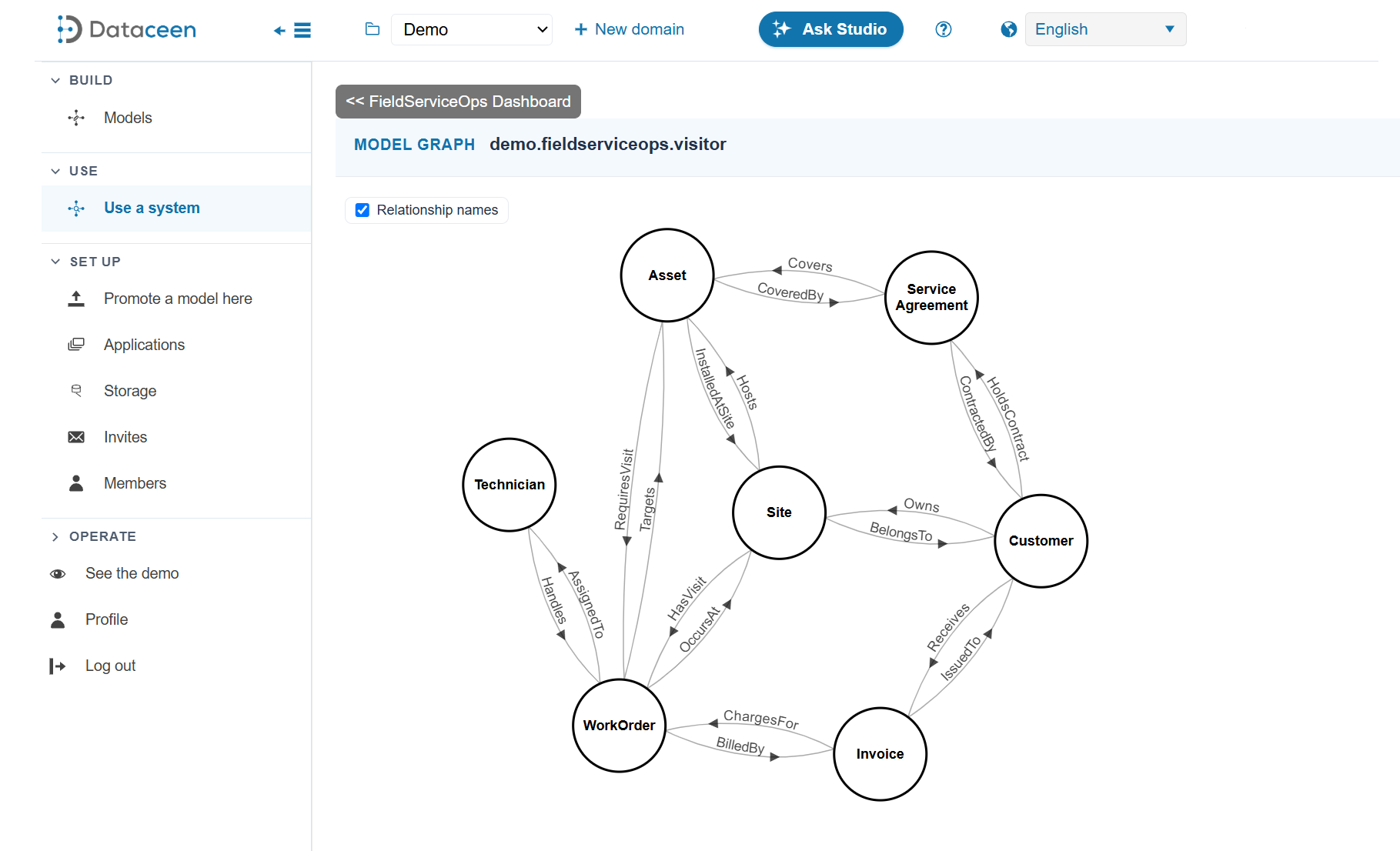
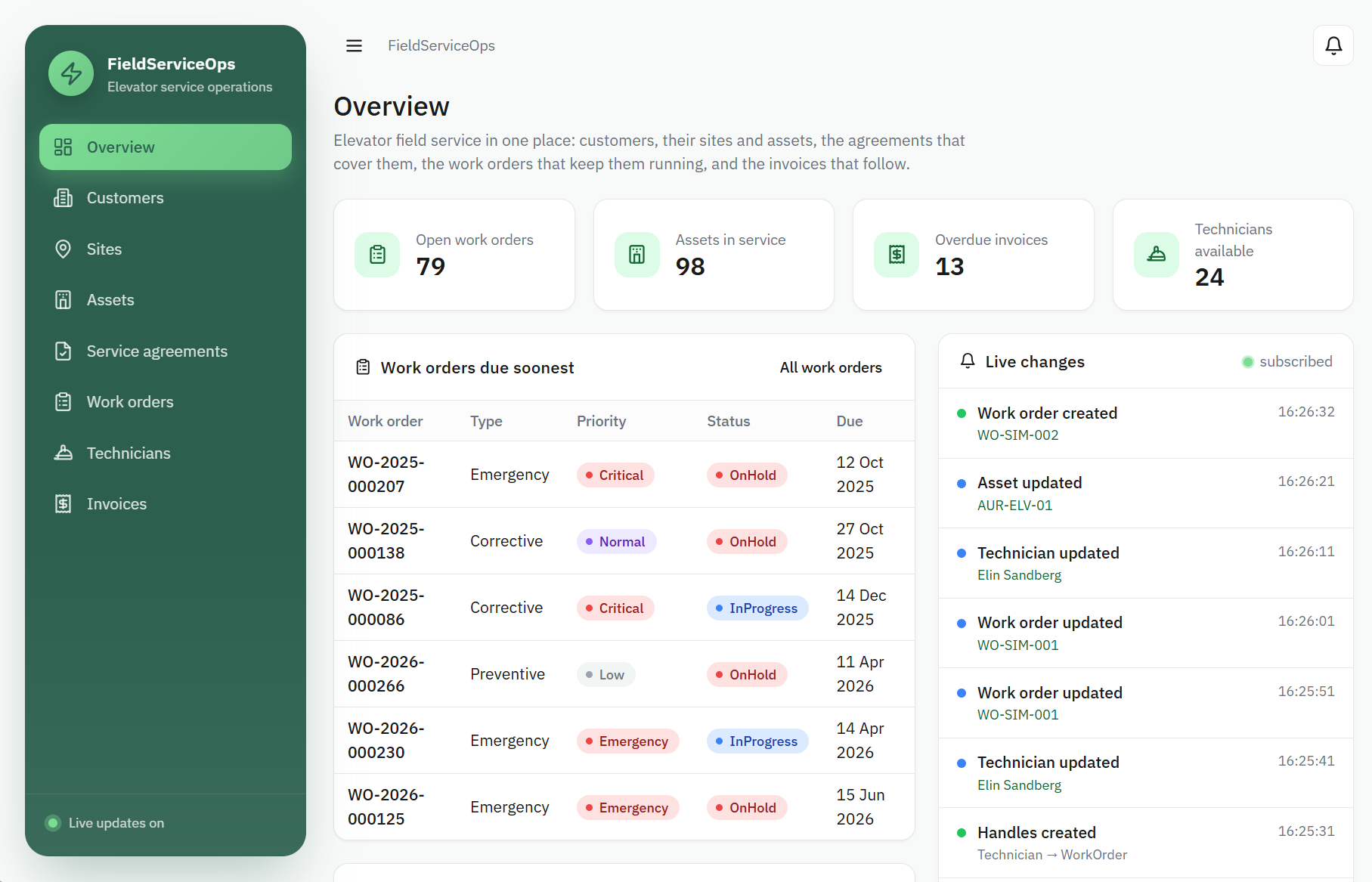
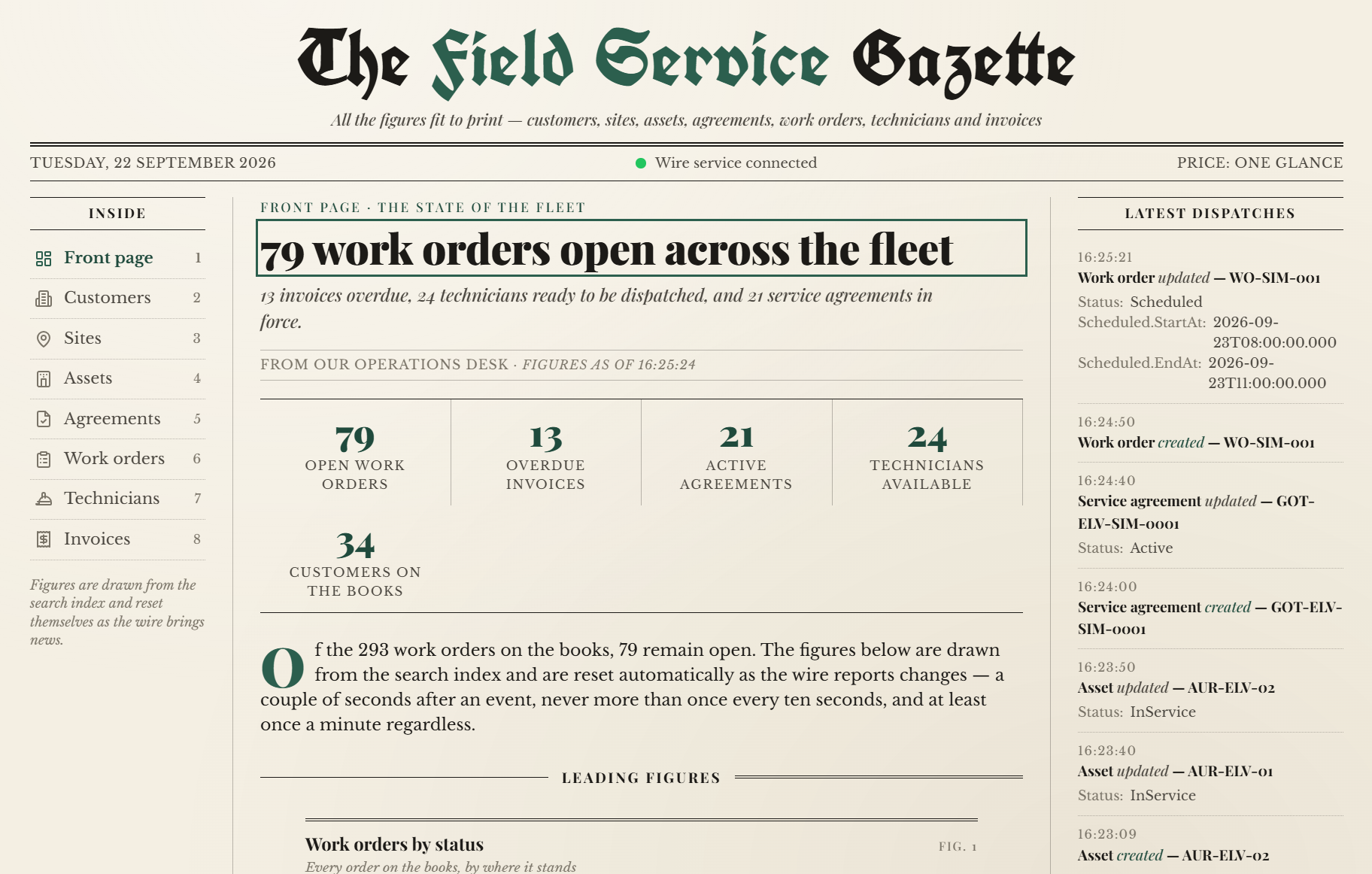
Your own system starts with a free account, or from Claude with none. A model is built in three to twenty minutes from a description.
Create free account →One boring question
Forget the demo. This is what it looks like on a Tuesday.
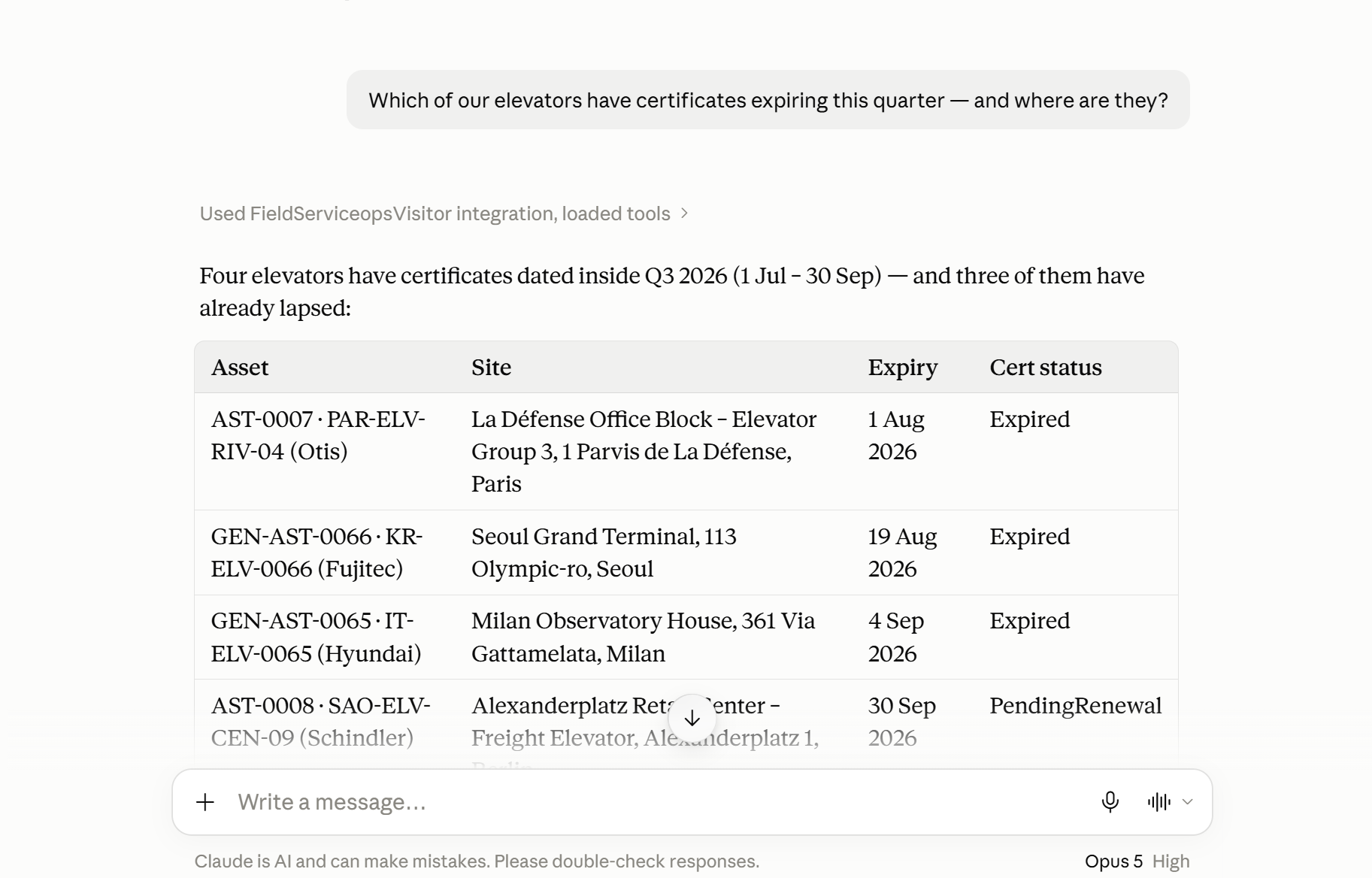
Which of our elevators have certificates expiring this quarter — and where are they?
- Asked in plain language.
- Answered from live data across systems.
- Under the permissions that already exist.
No transformation program required. That's the point.
Raw access isn't enough
Every enterprise AI project hits the same wall. The agent can reach the data, but three systems disagree on what a customer is, nobody has written down which fields it may change, and the permissions live in integration code and people's heads. That isn't a data quality problem. It's missing context.
With raw data access
- The agent guesses what fields mean
- Definitions differ between systems
- Permissions are reimplemented for every consumer
- Every new app or agent is a new integration project
- No record of what the agent did or why
With Dataceen
- Entities, relationships and rules are defined once
- The same meaning in the API, the SDK, the search index and the MCP tool
- Permissions come from your directory and apply to humans and agents alike
- New consumers reuse the model instead of rebuilding it
- Every change is recorded as an event you can replay and audit
A semantic model — not as a diagram, but as executable context.
Sound familiar?
Four situations we hear every week. Each one ends the same way: describe the data once, and Dataceen generates what the situation needs.
“Management wants AI on our data. Security keeps saying no.”
Both are right. Dataceen exposes your data through MCP tools that inherit your directory's roles and permissions — every call governed, logged and auditable. AI agents get access the way people do: safely.
Start from: a database schema or API spec.
“Answering our customers' questions takes three systems and two phone calls.”
Describe the data once. Dataceen generates the API, the search and the AI tools that answer plain-language questions from live data — under the permissions that already exist.
Start from: API specs, schemas or documents.
“The portal has been postponed twice. Every integration is quoted in months.”
From your model, Dataceen generates the foundation — APIs, typed SDKs, documentation and ready-made instructions for coding agents. The system you've postponed becomes days of work, not quarters.
Start from: what your systems already expose.
“Honestly? We're tired of AI pitches. We need integrations, permissions and audit sorted.”
Fair. Dataceen doesn't require an AI strategy: generated APIs, fine-grained access control and a complete event trail solve the everyday problem. And if you ever do want AI on your data — it's already safe.
Start from: a database schema, or even a PDF describing the domain.
How Dataceen works
From the knowledge you already have, to a generated software foundation — in three simple steps.
Describe your data
You don't start from a blank page. Begin from what you already have: API definitions, database schemas, PDF documentation, internal models, integration specifications or business descriptions.
Dataceen generates the foundation
Dataceen creates the semantic model and generates everything around it: databases, secure APIs, MCP tools, SDKs, documentation, search, event streams and instructions for coding agents. When the model changes, everything changes with it.
Build, integrate and automate
The generated system can be used by developers, AI coding agents, vibe-coding tools like Lovable and Base44, legacy system integrations, dashboards, admin tools, applications and automation.
From model to working software
Once Dataceen has generated your system, your team gets a complete foundation for building applications, dashboards, integrations and automations — with SDKs, APIs and AI-ready instructions included.
Create the foundation
Dataceen turns your semantic model into a working system with databases, secure GraphQL APIs, MCP tools, search, event recording, subscriptions, documentation and example data.
Download ready-to-use SDKs
Developers can download SDKs generated for the model, including typed clients, examples, quickstarts and documentation for building against the Dataceen APIs.
Build with developers and AI agents
Dataceen includes instructions that help AI coding agents and developers work from the same model, APIs and SDKs. Use them to create dashboards, admin tools, applications and integrations faster.
Integrate and automate
Use the generated APIs, MCP tools and event flows to connect legacy systems, synchronize data, trigger notifications and create operational automation.
One generated foundation. Many ways to build on it.
What you get
Everything generated from the same model — so nothing drifts apart.
Secure APIs
A GraphQL API generated from the model, with authentication, validation and fine-grained access.
AI agent access (MCP tools)
Model Context Protocol tools so AI agents can query and act on your data safely.
Developer SDKs
Generated SDKs in six languages, C#, TypeScript, Python, Go, Java and Kotlin, each a published package.
Documentation
Human- and AI-friendly docs with schemas, examples, and change tracking.
Search & events
Typo-tolerant text search, nearest first, aggregations and saved searches, plus a stream of every change as it happens.
Example data
A coherent, believable world in the business's language and place, not random rows.
Search that comes with the model
How search works →- Text search that tolerates typos and ranks by relevance.
- Nearest first for anything with an address.
- Saved searches that tell you when a new match appears.
Enterprise-ready by design
Your business controls where Dataceen-managed data is stored.
Why teams choose Dataceen
A governed layer between your business data and everything that consumes it.
One model, many consumers
A single semantic graph model powers APIs, SDKs, search, docs, and AI tools — no redundant models to maintain.
Secure by design
Role-based access, field-level permissions, row filters, and audit logs built in from day one.
Ready for AI agents
MCP tools generated from the model give agents the business meaning, the relationships and the permissions they need — the same ones your developers use.
Faster app & integration development
A model in three to twenty minutes from a description, an application live in 10 to 40, instead of hand-building integration layers.
Your data, your control
Dataceen does not force your operational data into a proprietary storage layer. Your business can control where Dataceen-managed data is stored, supporting compliance, governance, data residency, and enterprise security requirements.
One foundation. Developers and AI agents build from the same model.
AI agents don't replace developers. Dataceen gives developers and AI agents the same trusted model, APIs, SDKs and instructions — so dashboards, applications, integrations and automation stay aligned with one secure data foundation.
Give your AI agents — and your developers — the same understanding of your data.
Describe your business once. Dataceen generates the secure foundation around it: APIs, MCP tools, SDKs, search, events, documentation and permissions — with your data staying in your control.